On Friday, May 9, Ambassador Charles Snetter, representing the President, broke the ground for the reconstruction of the National Fish Hatchery in Klay, Bomi County. The hatchery is a component of the World Bank-funded US$40 million Liberia Sustainable Management of Fisheries Project (LSMFP), signed in 2021 to improve fisheries management. It is expected to be completed in 12 months. There will be dedicated spawning areas for tilapia, catfish an Heterotis, with an ambitious annual output target of 45 million tilapia fingerlings, and a total of 1.5 million catfish and Heterotis fingerlings.
By ensuring the constant availability good quality seed for farmers, it is expected that the project will enable a substantial rise in national aquaculture production from the current 2,000 metric tonnes. The Hatchery project will cover the installation of a fish health laboratory and a feed mill with a 10-ton daily production capacity.
Acting Director General of the National Fisheries and Aquaculture Authority (NAFAA), Cyrus Saygbe said the hatchery will deal with the challenges faced by local fish farmers, especially the limited access to affordable, high-quality fingerlings. He said that the facility will operate a Public-Private-Partnership model. The hatchery will not only produce commercial-grade fingerlings but also serve as a center for training, research, and innovation. It will include a research and development wing focused on local fish feed production and collaborate with institutions like CARI to develop evidence-based aquaculture practices tailored to Liberia’s environment.
Saygbe said the facility will operate under a Public-Private Partnership (PPP) model, with NaFAA competitively recruiting a private firm to manage it. He noted the model would attract investment, stimulate innovation, and link producers to markets, buyers, and processors. World Bank Country Manager Georgia Wallen said that ‘This hatchery will provide a sustainable source of affordable protein, job opportunities for women and youth, and open up growth for smallholder farmers and the private sector,’.
A unique expectation from the facility is the commercial production of Heterotis niloticus, a species common to West African bodies. It has not thrived under capture conditions due to challenges with seed multiplication and its non-acceptance of commercial feed. In Liberia, though, fish farmers have had some success with it, and officials of the NAFAA are confident that it will help drive increased aquaculture output in Liberia.
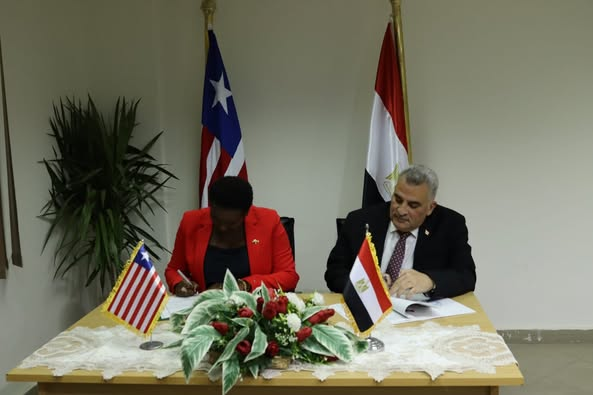
In November, last year, the former Director-General of the NAFAA, Meteh Blassco, on behalf of the Liberian government, signed a technical cooperation MOU with Major General AlHussein Farahat Mohamed, Executive Director of Lakes and Fish Resources Protection and Development Agency of the Arab Republic of Egypt. A major objective of the pact is to strengthen Liberia’s aquaculture sector through training of fish farmers, University and other technical personnel.
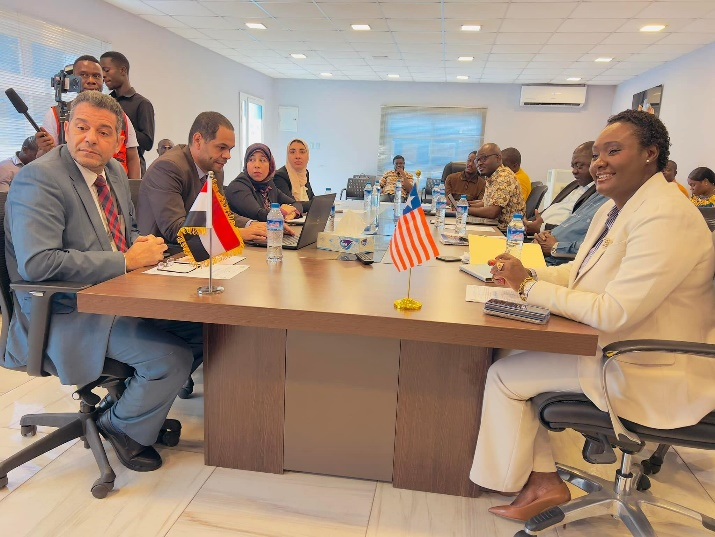
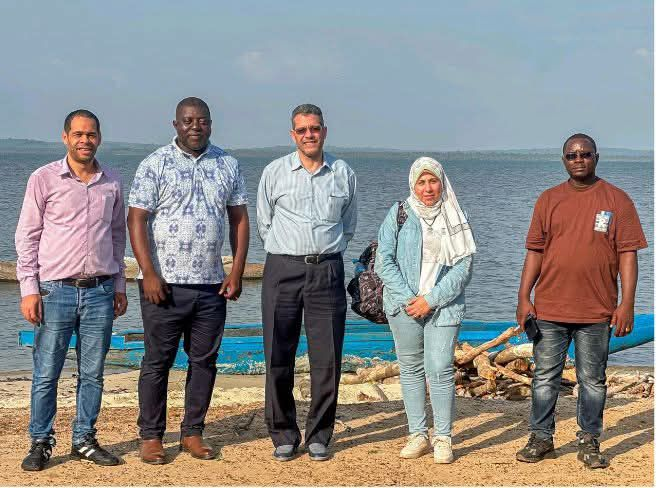
Last January, an Egyptian technical delegation led by Dr. Ahmed Saneyeldin Mohamed Sadek and accompanied by officials of the National Fisheries and Aquaculture Authorities, did a 7-day tour of aquaculture facilities in four Liberian counties. They were accompanied by Mr. Zizi Kpadeh, Director of Aquaculture of the National Fisheries and Aquaculture Authority. The purpose of the tour was to enable them assess the level of support to be delivered.
Ms Blassco and Major General Mohamed signing the MOU Liberian and Egyptian officials pictured in Cairo after the signing of the MOU
Dr. Ahmed Sadek, leader of the Egyptian team and Ms Meteh Blassco, Director-General of the National Fisheries and Aquaculture Authority at the forefront with other officials meeting in Monrovia.
Dr. Ahmed Sadek, leader of the Egyptian team, third from left, with Mr. Zizi Kpadeh, Director of Aquaculture, on site in Liberia with other officials